
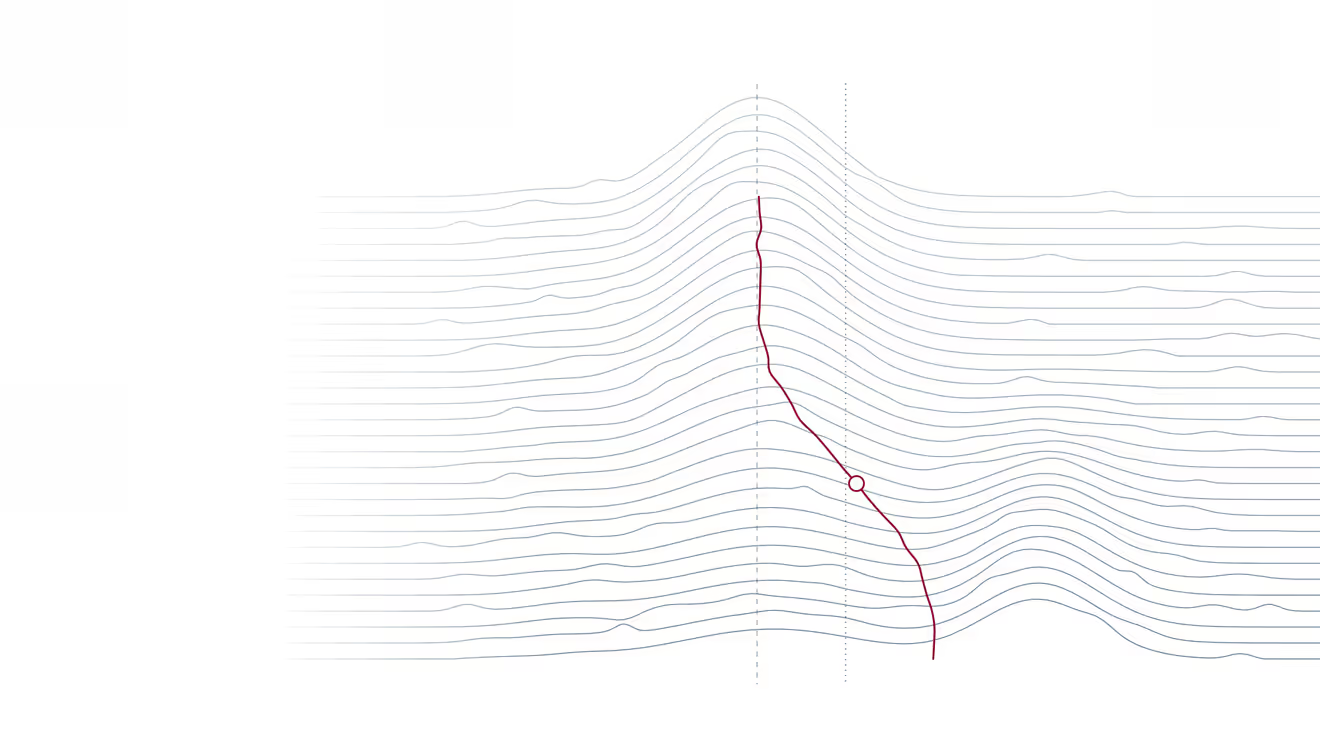
What changes after go-live
Validation before go-live measures a model against one population, on one set of devices, at one time. Deployment changes all three and adds the people who use it. A model’s performance at a site is therefore a quantity that moves, not a property it was certified with, and it has to be measured where the model runs.
The changes come from six places. Patients and case mix move with seasons, services and referral pathways. Scanners, software versions and laboratory assays change what the inputs look like. Interfaces get remapped and fields arrive empty. Clinicians lean on the model, or learn to ignore it. Practice changes what an outcome means. And the model itself changes, when its manufacturer ships a new version or the site moves a threshold.
What changes after go-live
Six sources of change, the kind of shift each causes, a published example, and the cheapest signal that would see it first. Filtering narrows what is shown; every source stays in the page.
Kind of change
Showing 6 of 6
- Prevalence shiftsInputs shift
Patients and case mix
Who arrives changes: a season, a new service, a referral pathway, a pandemic. Both how common the condition is and what the inputs look like can move.
When COVID-19 arrived, the share of inpatients triggering one widely used sepsis model’s alert more than doubled, from 9% to 21% a day, across 24 hospitals, while census fell by a third.
Published study · alert volume only, accuracy not evaluated
Seen first by · Output distribution and alert rate
- Inputs shift
Devices, software and protocols
A new scanner, a reconstruction setting, a software upgrade on the acquisition system or a new laboratory assay changes what the inputs look like, often invisibly to a person.
After a software upgrade on the mammography equipment, a commercial screening model’s recall rate rose about threefold, and thresholds had to be set per software version.
Published study
Seen first by · Output rate split by device and software version
- Data breaks
Upstream data and pipelines
An interface is remapped, a field arrives empty, a unit changes, a record is duplicated. Nothing about the patients moved; the data stopped meaning what the model expects.
FDA’s draft guidance on AI-enabled devices lists missing values, duplicate records and data type mismatches as pipeline failures a monitoring plan should catch.
Regulator’s list, draft guidance
Seen first by · Data quality checks on the inputs
- Use changes
Clinicians and workflow
Deploying a model changes how people work. Some lean on it more than they should, some learn to ignore it, and the workflow around it moves.
In a reader study, when purported AI suggestions for mammograms were wrong, radiologists’ accuracy fell sharply at every experience level, least for the most experienced.
Reader study, reported second-hand
Seen first by · Override and acceptance rates; disagreement with the reader
- Meaning shifts
Practice and definitions
A guideline changes, a coding rule changes, or the model’s own alerts lead to earlier treatment so the outcome it predicts happens less. The same inputs now mean a different outcome.
No published case from a deploying organisation was found to cite. FDA’s draft guidance names changing disease patterns and users’ behaviour as causes of performance change; the mechanism is stated here without an example.
Mechanism only
Seen first by · Performance against confirmed outcomes, and nothing earlier
- Model changes
The model itself
The manufacturer ships a new version, a hosted service changes behind its interface, or the site changes a threshold. The patients did not move; the thing measuring them did.
The RCR reports a nodule volumetry update after which the old and new versions disagreed on nodule count in 80% of re-run scans. A hosted language model’s answers on the same tasks have changed between versions without notice.
Professional body’s case; preprint
Seen first by · The version recorded on every output
Wong et al., JAMA Network Open 2021; de Vries et al., Radiology: Artificial Intelligence 2023; FDA draft guidance on AI-enabled device software functions, January 2025; Dratsch et al., Radiology 2023; Royal College of Radiologists, March 2026; Chen, Zaharia and Zou, arXiv 2307.09009.
For imaging, the site-caused version of this problem, a new scanner, a contrast protocol or a reconstruction update, is set out in the on-premises and hybrid clinical AI framework. This piece covers clinical AI generally, of which imaging is one case.
The clearest published case of a population change moving a deployed model is the COVID-19 surge. Across 24 US hospitals in four health systems, alerts from one widely used sepsis model rose 43% a day in the three weeks after each system’s first COVID-19 case, while the number of patients in hospital fell by a third. The authors did not measure accuracy, so the study does not show that the model got worse. It shows that the model’s output moved with the population, and that the cheapest signal a site has would have seen it.
A rising alert rate does not by itself mean a worse model. If the condition becomes more common, a model with unchanged sensitivity and specificity alerts more often, and more of its alerts are right. Prevalence is the first thing to rule out before reading anything into an output rate.
Same model, different prevalence
Arithmetic · illustrative inputsSet the model’s sensitivity and specificity, and how common the condition was when it was validated and is now. Nothing about the model changes. Watch what happens to the share of its alerts that are right.
- PPV at validation
- 30%
- alerts that are right
- PPV now
- 59%
- same model
- NPV at validation
- 98.8%
- all-clears that are right
- NPV now
- 96.2%
- same model
Per 1,000 cases
At validation · prevalence 5.0% · 135 alerts: 40 right, 95 wrong · 10 cases missed
Now · prevalence 15.0% · 205 alerts: 120 right, 85 wrong · 30 cases missed
From 5.0% to 15.0% prevalence, the share of alerts that are right goes from 30% to 59% and alerts per 1,000 cases from 135 to 205, with the model unchanged.
Bayes’ rule with fixed sensitivity and specificity. Every input is the reader’s; the defaults are illustrative and describe no particular model.
Who is watching
The manufacturer and the deploying organisation watch for different things. The manufacturer surveils its installed base under rules that are specific and mostly binding. Only the deployer sees its own patients, devices and workflows, and its duty to measure whether the model still works is thinner and less specific. Where a deployer duty does exist, it is narrow.
In the United States the detailed instruments face the manufacturer. FDA’s guidance on predetermined change control plans, reissued in August 2025, expects a plan to say how users are told of an update and anticipates the manufacturer monitoring performance over time. FDA’s January 2025 draft guidance on AI-enabled device software describes a post-market performance monitoring plan in more detail than any other regulator, and it is still a draft. FDA’s 2025 request for comment on measuring real-world performance closed in December 2025 and is not guidance. How the US approval paths work is covered in Clinical AI regulation: intended use determines the path.
Three US instruments reach the organisation that runs the model, and none of them asks it to measure performance. Since May 2025 the Section 1557 rule, 45 CFR 92.210, has given covered entities an ongoing duty to make reasonable efforts to identify decision support tools that use race, colour, national origin, sex, age or disability as inputs, and to mitigate the risk of discrimination. ONC’s HTI-1 criteria require certified EHRs to support a source attribute for a predictive tool’s “validity of intervention in local data” and to let the hospital record it, without requiring anyone to fill it in; HTI-5 has proposed removing those requirements. And the Joint Commission and the Coalition for Health AI published voluntary guidance in September 2025 that names local validation and monitoring.
Canada’s instrument is guidance addressed to manufacturers. Health Canada’s pre-market guidance for machine learning-enabled medical devices, published in April 2026, says manufacturers should consider describing monitoring plans for degradation over time, input shift and changed inputs, and should consider telling users how to perform local validation and ongoing monitoring. What binds is the Minister’s power to put terms and conditions on a device licence.
Ontario’s Enhancing Digital Security and Trust Act, 2024 lets the province require prescribed public sector entities to manage the risks of AI and document its performance and monitoring, but no regulation has been made under its AI provisions. Hospitals are prescribed under its cyber security regulation, in force since July 2026, which says nothing about AI. The nearest Ontario document addressed to the deploying organisation is the Information and Privacy Commissioner’s January 2026 guidance on AI scribes, which asks custodians to monitor on a schedule and when thresholds of unexpected behaviour are crossed, and to set thresholds for switching a system off.
The EU is the one place a statute says deployers shall monitor. Article 26 of the AI Act has deployers of high-risk systems monitor operation against the instructions for use, inform the provider, suspend use where they see a risk, and keep the system’s logs for at least six months. For medical devices it applies from 2 August 2028. In the UK the manufacturer carries post-market surveillance, while imaging providers have since October 2024 had to keep an inventory of interpretation software recording the version in clinical use. The Royal College of Radiologists’ March 2026 guidance puts post-deployment monitoring on the deploying institution.
Who is asked to watch
Eighteen instruments, the party each addresses and its status in words. Filter by party, status or place. Every row stays in the page; filtering only narrows what is shown.
Addressed to
Status
Where
Showing 18 of 18 · 4 binding on the deploying organisation
US
GuidanceFinal, reissued 18 Aug 2025
FDA guidance on predetermined change control plans for AI-enabled devices
Addressed to · Manufacturer
A plan a manufacturer may choose to submit. Its update procedures should say how users are told of a change, and FDA anticipates the manufacturer monitoring safety and performance over time.
US
ProposedDraft since 7 Jan 2025
FDA draft guidance on AI-enabled device software functions, §XI
Addressed to · Manufacturer
Manufacturers should have a post-market performance monitoring plan covering changes in demographics or prevalence, input shift, broken data and users’ behaviour. Generally not required for a 510(k).
US
In forceAmended Part 820 since 2 Feb 2026
21 CFR Parts 803, 806 and 820
Addressed to · Manufacturer
Report deaths, serious injuries and malfunctions, and corrections and removals; run a quality management system that handles design changes and corrective action.
US
ProposedComments closed 1 Dec 2025
FDA request for comment on measuring real-world AI device performance
Addressed to · Manufacturer
Asked how to measure performance in use, detect drift, and set triggers and responses. States that it is neither draft nor final guidance.
US
In forceIn the eCFR, October 2026
ONC HTI-1, 45 CFR 170.315(b)(11)
Addressed to · Certified health IT developer
Certified EHRs must support 31 source attributes for predictive tools, including validity and fairness “in local data”, and let the hospital’s users record and change them. Nothing requires anyone to fill them.
US
ProposedProposed 29 Dec 2025
ONC HTI-5 proposed rule
Addressed to · Certified health IT developer
Would remove the source-attribute and risk-management requirements above. No final rule found by mid-October 2026.
US
In forceSince 1 May 2025
Section 1557 rule, 45 CFR 92.210
Addressed to · Deploying organisation
An ongoing duty to make reasonable efforts to identify decision support tools that use race, colour, national origin, sex, age or disability as inputs, and to mitigate the risk of discrimination. About discrimination, not performance.
US
GuidanceReleased 17 Sept 2025
Joint Commission and CHAI, responsible use of AI in healthcare
Addressed to · Deploying organisation
Voluntary guidance naming local validation and monitoring among its elements. Not an accreditation requirement.
Canada
GuidancePublished 1 Apr 2026
Health Canada pre-market guidance for machine learning-enabled devices
Addressed to · Manufacturer
Manufacturers should consider describing monitoring plans for degradation, input shift, changed inputs and changed handling of outputs, and should consider telling users how to do local validation and ongoing monitoring.
Canada
In forcePower exercisable at any time
Medical Devices Regulations, s. 36
Addressed to · Manufacturer
The Minister may impose or amend terms and conditions on a device licence, which the guidance says can strengthen ongoing safety and effectiveness.
Ontario
Nothing madeNo AI regulation as of 13 Oct 2026
Enhancing Digital Security and Trust Act, 2024, ss. 5–7
Addressed to · Deploying organisation
Lets the province require prescribed public sector entities to manage AI risks and document performance and monitoring. No entity has been prescribed under these sections and no AI regulation made.
Ontario
In forceSince 1 Jul 2026
O. Reg. 51/26, cyber security
Addressed to · Deploying organisation
Public hospitals must run a cyber security program, assess maturity every two years and report critical incidents within 72 hours. Nothing on AI.
Ontario
GuidancePublished 28 Jan 2026
IPC Ontario, AI scribes: key considerations
Addressed to · Deploying organisation
Custodians should monitor and test on a schedule and when thresholds are crossed, vet automatic vendor updates, and set thresholds for turning a system off. Anchored to PHIPA’s accuracy duty.
EU
Applies laterFrom 2 Aug 2028 for devices
AI Act, Article 26
Addressed to · Deploying organisation
Deployers of high-risk systems shall monitor operation, inform the provider, suspend use where they see a risk, assign competent human oversight, and keep the system’s logs for at least six months.
EU
Applies laterFrom 2 Aug 2028 for devices
AI Act, Article 72
Addressed to · Manufacturer
Providers run a post-market monitoring system that collects performance data, including data from deployers, and may fold it into their medical device surveillance.
UK
In forceSince 16 Jun 2025
GB post-market surveillance regulations, SI 2024/1368
Addressed to · Manufacturer
Manufacturers keep a surveillance system proportionate to risk, with performance monitoring through the device’s life. Users report through the Yellow Card scheme.
UK
In forceSince 1 Oct 2024
IR(ME)R 2017, reg. 15(2A), as amended in 2024
Addressed to · Deploying organisation
For imaging that uses ionising radiation, the inventory must list each piece of interpretation software with its current version and the year that version went into clinical use.
UK
GuidancePublished March 2026
Royal College of Radiologists, post-deployment monitoring guidance
Addressed to · Deploying organisation
Monitoring is the deploying institution’s: a named responsible person, an inventory, people, process and product, and audit frequency and thresholds defined locally.
Each row read at the issuing body on 16 October 2026: FDA, eCFR, Federal Register, canada.ca, Ontario e-Laws, IPC Ontario, the AI Act text, legislation.gov.uk, MHRA, the RCR and CHAI. The EU dates are from Regulation (EU) 2026/1744. What an instrument says is not advice on whether it binds a particular organisation.
So the local question, whether a model still works for this site’s patients, is often nobody’s job. The figures on practice fit that. In 2023, 65% of US hospitals used predictive models; of those, 61% had evaluated them for accuracy with their own data and 44% for bias. Those are evaluations, which may have been done once, not ongoing monitoring.
The manufacturer’s side of the evidence, including what a change control plan asks the platform to produce, is in The data platform is the evidence package. This piece stays on the deployer’s side.
The signals, from cheapest to most expensive
Signals come in order of cost. Input and output distributions are available as cases run and say that something changed. Process signals say how clinicians are responding. Performance needs a confirmed outcome, which arrives late, partly, and skewed towards the cases the model flagged.
The order matters because the cheap signals cannot answer the question that matters most. An input shift can be harmless, and a harmful change can leave the inputs looking the same. A 2024 scoping review of methods for monitoring clinical AI found 39 sources, of which nine reported any clinical implementation, and noted that the link between label-free signals and real performance is hard to predict.
The signals, cheapest first
Nine signals in order of what they cost. Each says what it detects, what it needs, and what it cannot tell you. Filter by the data a signal needs or by when it can exist.
Needs
Available
Showing 9 of 9 · 7 need no confirmed outcome
Data quality on the inputs
Needs · The model’s own recordAs cases runDetects
Empty fields, changed units, remapped codes, duplicates: the pipeline breaking rather than the population moving.
Cannot tell you
Anything about patients. A clean feed can still describe a population the model was not built for.
Methods · Completeness, conformance and plausibility rules; the platform’s quality component
Input distributions
Needs · The model’s own recordAs cases runDetects
That what the model is seeing has moved away from what it was validated on: ages, lab values, image statistics.
Cannot tell you
Whether the model got worse. A shift can be harmless, and a harmful change can leave inputs looking the same.
Methods · Kolmogorov–Smirnov, population stability index, Wasserstein distance; control charts
Output distributions and alert rate
Needs · The model’s own recordAs cases runDetects
That the model is saying something different: more alerts, a shifted score distribution, a flag rate that tripled.
Cannot tell you
Whether the new rate is right. When prevalence rises, a correct model alerts more.
Methods · Rate per day or per device; score histograms; control charts
What clinicians did with it
Needs · What clinicians didAs cases runDetects
Overrides, acceptances and ignored alerts: whether the output is being used, and how that is changing.
Cannot tell you
Who was right. A rising override rate is fatigue, a worse model or a better-calibrated clinician.
Methods · CDS Hooks feedback; the ONC feedback export; acknowledgement logs
Disagreement with the reader
Needs · What clinicians didWithin daysDetects
How often the model and the clinician’s own read differ, and whether that is moving.
Cannot tell you
The truth. The report is a reference, not a confirmed outcome, and the reader may have leaned on the model.
Methods · Report against output, by text search or language processing; sampled adjudication
Uncertainty and out-of-range cases
Needs · The model’s own recordAs cases runDetects
Cases unlike the training data: an unfamiliar device in an image, values outside every range seen.
Cannot tell you
Much, unless the model reports a spread at all. An ensemble’s spread is not a guaranteed interval.
Methods · Ensemble variance; distance from training data; out-of-range rules
Estimated performance without labels
Needs · The model’s own recordAs cases runDetects
An estimate of accuracy from the model’s own calibrated confidence, before any outcome exists.
Cannot tell you
A change in what the inputs mean. These methods assume the relationship holds, and a 2025 preprint found failure modes under shift.
Methods · Confidence-based estimation; importance weighting
Performance against confirmed outcomes
Needs · Confirmed outcomesAfter the labelDetects
Whether the model is still right: sensitivity, specificity, calibration, on this site’s patients.
Cannot tell you
Anything quickly, and nothing unbiased if outcomes are confirmed mainly for flagged cases.
Methods · Periodic audit against a reference; control charts on errors
Performance by subgroup
Needs · Confirmed outcomesAfter the labelDetects
A fall concentrated in one group that the pooled figure hides.
Cannot tell you
Anything for small groups for a long time. Every split divides the labelled cases again.
Methods · The same metrics, stratified; the US Section 1557 duty is about inputs, not these
FDA draft guidance §XI; Andersen et al., JBI Evidence Synthesis 2024; Royal College of Radiologists 2026; CDS Hooks 2.0; 45 CFR 170.315(b)(11); Wong et al. 2021; Begg and Greenes 1983; Seyyed-Kalantari et al. 2021. No signal carries a fixed lag: when a label exists depends on how the outcome is defined.
Drift tests carry a trap at volume. The Kolmogorov–Smirnov test’s threshold shrinks with the square root of the sample, so at a few thousand cases a window it flags shifts far too small to act on. The population stability index has the opposite problem: its familiar cut-offs of 0.1 and 0.25 come from credit scoring and carry no error rate. Neither number is a trigger on its own. Decide in advance what size of shift matters, then test for that.
How small a shift a drift test will flag
Arithmetic · alpha 0.05Set how many cases fall in each comparison window. The panel gives the Kolmogorov–Smirnov threshold and the smallest shift in a normally distributed feature’s mean that would cross it. More cases make the test more sensitive, not more meaningful.
Illustrative input. A week of one model at one site, or a month, or a year.
Compared against
- Threshold D
- 0.086
- largest gap between the two curves
- Smallest flagged shift
- 0.22 SD
- in a normal feature’s mean
A p-value is not a trigger. At a few thousand cases a window the test flags shifts of a few hundredths of a standard deviation, smaller than any clinician would act on. Decide in advance how large a shift matters, and test for that.
The PSI cut-offs are not this. The population stability index’s 0.1 and 0.25 come from credit scoring and are used without reference to error rates. They are rules of thumb, not significance levels, and their meaning changes with the number of bins and cases.
Two-sample Kolmogorov–Smirnov asymptotic threshold, c(0.05) = 1.358, computed from the Kolmogorov distribution. Normal feature assumed for the shift. PSI: Yurdakul, Statistical Properties of Population Stability Index, Western Michigan University, 2018.
The label problem
Performance needs ground truth, and ground truth has three problems. It is late, because some outcomes cannot exist until a window closes: a 30-day readmission cannot be known for 30 days. It is partial, because many cases never reach a confirmed outcome. And it is biased, because the cases that do reach one are mostly the cases the model flagged.
Labels are also constructed. The external validation of one widely used sepsis model, published in JAMA Internal Medicine in 2021 and carried out at a single academic medical centre, defined sepsis as meeting CDC surveillance criteria, or as an ICD-10 sepsis diagnosis with inflammatory and organ-dysfunction criteria within six hours of each other. Its results belong to that definition, and a site comparing its own monitoring with them has to use the same one. The study’s results are drawn in the regulation piece.
The bias has a name and a 1983 paper. Begg and Greenes showed that sensitivity and specificity computed only from verified cases are biased whenever the decision to verify depends on the test result. A model that flags a case sends it towards confirmation; a case it misses often goes home. A site measuring accuracy on its confirmed cases sees a sensitivity higher than the truth.
Verification bias, worked through
Arithmetic · illustrative inputsSet the model’s true sensitivity and specificity, and how often a flagged and an unflagged case go on to a confirmed outcome. The panel shows what a site computing accuracy from its confirmed cases would see.
- Measured sensitivity
- 97%
- true 80%
- Measured specificity
- 50%
- true 90%
Sensitivity
Specificity
Confirming 90% of flagged cases and 10% of the rest, the site would report sensitivity of 97% for a model whose true sensitivity is 80%, and specificity of 50% against a true 90%.
Begg and Greenes, Biometrics 1983. Assumes the chance of confirmation depends only on whether the model flagged the case. Prevalence cancels out. Every input is the reader’s.
The Royal College of Radiologists’ guidance gives the practical compromise. To detect change over time, full adjudication may not be needed if the same method is applied consistently. To state sensitivity and specificity, cases need manual review against a reference.
How long it takes to see a change
Seeing a real drop takes volume and time, and the arithmetic is simple enough to run with your own numbers. Sensitivity is read only on cases that turn out positive, and only on those with a confirmed outcome, so prevalence and label coverage divide the yield before volume does anything. For a low-volume, low-prevalence model, a site’s own data may not show a meaningful fall for a long time, and the site has to decide in advance what it will rely on instead.
How long it takes to see a fall
Arithmetic · alpha 0.05 · power 0.80Your volume, how common the condition is, the model’s baseline, the fall worth catching, and how labels arrive. The panel gives how many confirmed cases that takes, and how long. Defaults are illustrative inputs, not typical values.
Measure
Compared against
- Confirmed positives
- 114
- one-sample
- Cases run
- 2,280
- 5.0% are positives · 100% confirmed
- Collecting
- 2.3 months
- at this volume
- To a result
- 3.3 months
- plus the wait for the last label
Sensitivity from 85% to 75%: 114 confirmed positive cases, 2,280 cases run, 2.3 months collecting and 3.3 months to a result at 1,000 cases a month.
The formula
N = ( z(0.975)·√(p0(1−p0))
    + z(0.80)·√(p1(1−p1)) )²
    / (p0 − p1)²

cases = N / (share × confirmed)
months = cases / volume + label wait
Against our own earlier period, both proportions are estimates, and the two-sample form gives N for each period: the earlier one has to exist already.
What it assumes
- Cases are independent, and the baseline is either known or measured on a period of the same size.
- The normal approximation holds, which it does not when few events are expected.
- One test, at the end. Checking every month is repeated testing and raises false alarms.
- Confirmed cases are like the unconfirmed ones. If only flagged cases get checked, they are not.
Sample size for a proportion, NIST/SEMATECH e-Handbook of Statistical Methods §7.2.4.2; two-sample form for a locally measured baseline. Every input is the reader’s; the defaults describe no particular model.
The calculator differs from the detection horizon in Imaging AI: six handoffs between the scanner and the chart, which counts studies against a fixed concordance rate. Here prevalence, label coverage and label wait decide how many of the cases a model runs can count at all, and the comparison can be against a validated figure or against the site’s own earlier period, which needs the larger two-sample count for each period.
When the answer is too long, the cheaper signals carry the load: an alert rate, an override rate, disagreement with the reader, the version recorded on every output. They do not prove the model is worse. They say when to look harder, which is what a monitoring plan needs from them.
Watching a running total: control charts
A control chart watches a running total rather than a monthly snapshot. The cumulative sum, or CUSUM, introduced by Page in 1954, accumulates small excesses and signals when the total crosses a threshold. The threshold trades how quickly a real change is caught against how often a stable process raises a false alarm.
Risk adjustment changes the question the chart asks. Steiner and colleagues’ risk-adjusted CUSUM, published in 2000 to monitor surgical outcomes, weights each case by its own expected risk. Applied to a model’s errors, it asks whether the model is doing worse than expected for these patients, rather than whether errors are rising. The two answers differ when the case mix changes.
Two control charts on the same cases
Simulation · stated modelA simulation, not data. The same simulated cases feed two charts: one that assumes every case carries the average risk of error, and one that adjusts for each case’s own risk. Choose what changes from month 7 and watch which chart signals.
What changes
From month 7, harder cases arrive. The model is unchanged.
Used only when the model gets worse.
Simulated. Unadjusted chart: 14 signals, the first in month 7. Risk-adjusted chart: no signal in 12 months.
| Month | 1 | 2 | 3 | 4 | 5 | 6 | 7 | 8 | 9 | 10 | 11 | 12 |
|---|---|---|---|---|---|---|---|---|---|---|---|---|
| Observed | 12% | 11% | 10% | 12% | 8% | 10% | 24% | 20% | 19% | 23% | 19% | 15% |
| Expected | 11% | 11% | 11% | 12% | 11% | 11% | 22% | 20% | 20% | 21% | 19% | 20% |
The unadjusted chart compares every month with 11.0%, the baseline average. When harder cases arrive, the observed rate rises and so does what the risk model expects; only the second chart knows that.
The model behind the chart
- Each case has a difficulty drawn from a normal distribution, mean 0, SD 1.
- The chance of a model error is logistic in difficulty: 8% at average difficulty.
- Harder cases: the mean difficulty moves to 0.8 from month 7.
- Worse model: the odds of an error multiply by the factor set above.
- The risk model is assumed correct, which is the best case for adjustment.
The chart, as it runs
W = log( RA / (1 − p + RA·p) )   on an error
W = log(  1 / (1 − p + RA·p) )   otherwise
S = max(0, S + W)   signal when S > h

RA = 2: tests a doubling of the odds
p  = p̄ for every case (unadjusted)
p  = the case’s own risk (adjusted)
Simulation only; seeded so the same inputs draw the same chart. Risk-adjusted CUSUM: Steiner, Cook, Farewell and Treasure, Biostatistics 2000, developed for surgical outcomes. Using it on a model’s errors needs a second model of each case’s expected error, which has to be built and validated too.
Two cautions come with it. A risk-adjusted chart on a model’s errors needs a second model, of each case’s expected error, which has to be built and validated too, and the method’s track record is in surgical outcomes rather than AI. And adjustment answers a narrower question than safety: if harder cases arrive and the model errs on them more often, patients receive more errors while an adjusted chart stays flat. A site needs both views.
What the platform has to record
Every signal above depends on the platform recording five things for every output and joining them: the model and its version, the input as the model saw it, the output and what the clinician was shown, what the clinician did, and the confirmed outcome. If one is missing, at least one signal cannot be computed after the fact.
Each record maps onto the platform components set out in What a healthcare data platform is made of. The version belongs in lineage and audit. The input snapshot is a data contract the site writes for itself, because no standard defines it. The outcome usually arrives through a different feed, days or weeks later, and the join that reconnects it to the output is the platform’s work.
Standards carry most of the records. In imaging, DICOM’s template 4019 makes the algorithm’s name and version mandatory content wherever it is used. In FHIR, an Observation can name the Device that produced it, and the Device can carry its version. CDS Hooks defines a feedback call that tells the service whether a clinician accepted or overrode a card. Nothing defines the input snapshot or the join.
The five records, as the standards carry them
One case, five records. Choose a record to see it in the form its standard gives it, what carries it, and what no standard says. The identifiers are examples.
Which model, which version, on every output
Carried by · FHIR Device.version, referenced from Observation.device · DICOM TID 4019
FHIR R4 Device, and the DICOM content items that carry the same facts
{
  "resourceType": "Device",
  "id": "sepsis-model",
  "deviceName": [{ "name": "Example sepsis risk model",
                   "type": "user-friendly-name" }],
  "manufacturer": "Example Manufacturer",
  "version": [{ "type": { "text": "model version" },
                "value": "2.1.4" }]
}

DICOM SR, TID 4019 Algorithm Identification
  (111001, DCM, "Algorithm Name")         TEXT  "Example nodule detector"   M
  (111003, DCM, "Algorithm Version")      TEXT  "3.1.2"                      M
  (122405, DCM, "Algorithm Manufacturer") TEXT  "Example Manufacturer"       U
What no standard says
Whether a server-side change to a hosted model must change the version string. Nothing requires it, so the site’s inventory has to record when it learned of each version.
The input exactly as the model received it
Carried by · No standard. The site defines it, pointing at versioned source resources
A site-defined snapshot, kept beside the output
{
  "inference": "inf-2026-10-16-000123",
  "model": "Device/sepsis-model|2.1.4",
  "scoredAt": "2026-10-16T14:22:00Z",
  "inputs": [
    { "loinc": "2524-7", "value": 3.1,  "unit": "mmol/L",
      "source": "Observation/lab-889/_history/2" },
    { "loinc": "8480-6", "value": 92,   "unit": "mm[Hg]",
      "source": "Observation/vs-4410/_history/1" },
    { "loinc": "6690-2", "value": 14.2, "unit": "10*3/uL",
      "source": "Observation/lab-890/_history/1" },
    { "loinc": "8310-5", "value": 38.6, "unit": "Cel",
      "source": "Observation/vs-4411/_history/1" }
  ],
  "mappingVersion": "lab-feed-map 2026.09"
}
What no standard says
Everything. Which values the model saw, after which mapping and which unit conversion, is recorded only if the site decides to record it. Without it, input drift cannot be computed after the fact.
The score, and what the clinician was shown
Carried by · FHIR Observation · DICOM SR measurement report (TID 1500 family)
FHIR R4 Observation with the model named on it
{
  "resourceType": "Observation",
  "status": "final",
  "code": { "coding": [{
    "system": "http://example.org/fhir/CodeSystem/local-models",
    "code": "sepsis-risk",
    "display": "Sepsis risk score (local code)" }] },
  "subject": { "reference": "Patient/example" },
  "effectiveDateTime": "2026-10-16T14:22:00Z",
  "valueQuantity": { "value": 0.87, "unit": "probability",
                     "system": "http://unitsofmeasure.org",
                     "code": "1" },
  "interpretation": [{ "text": "Alert shown: high risk, threshold 0.60" }],
  "device": { "reference": "Device/sepsis-model" }
}
What no standard says
Which threshold turned the score into an alert. A threshold the site changed is a change to the model’s behaviour, and only the site’s record says when it happened.
What the clinician did with it
Carried by · CDS Hooks 2.0 feedback · ONC’s feedback export for certified EHRs
CDS Hooks feedback, sent by the EHR to the service
POST {baseUrl}/cds-services/sepsis-risk/feedback

{
  "feedback": [{
    "card": "0b7f3c1e-5d4a-4c3e-9a51-2f6d8e1c4a90",
    "outcome": "overridden",
    "overrideReason": {
      "reason": { "system": "http://example.org/override-reasons",
                  "code": "already-treating",
                  "display": "Already being treated" },
      "userComment": "Antibiotics started 13:50" },
    "outcomeTimestamp": "2026-10-16T14:31:00Z"
  }]
}
What no standard says
Ignored cards. The specification sends accepted and overridden cards only, so an alert nobody acted on leaves no feedback, and the site has to log that it was shown.
The confirmed outcome, joined back to the output
Carried by · FHIR Condition or a coded diagnosis · the join itself: none
The outcome, and the join that makes the five one record
{
  "resourceType": "Condition",
  "code": { "coding": [{
    "system": "http://hl7.org/fhir/sid/icd-10-cm",
    "code": "R65.21",
    "display": "Severe sepsis with septic shock" }] },
  "subject": { "reference": "Patient/example" },
  "onsetDateTime": "2026-10-16T19:05:00Z",
  "recordedDate": "2026-10-21T09:12:00Z"
}

-- The join. The window is the site's own outcome definition.
SELECT i.inference, i.model_version, i.score, f.outcome,
       c.code AS confirmed
FROM   inference i
LEFT JOIN feedback  f ON f.inference = i.inference
LEFT JOIN condition c ON c.patient = i.patient
       AND c.onset BETWEEN i.scored_at
                       AND i.scored_at + :outcome_window;
What no standard says
The join, and the window. No standard says which outcome confirms which output, how long to wait, or what to do with cases that never get one.
FHIR R4 (4.0.1); DICOM PS3.16 2026d, TID 4019; CDS Hooks 2.0; 45 CFR 170.315(b)(11)(ii)(C); LOINC and ICD-10-CM codes checked on tx.fhir.org. Check a code’s meaning before using one: LOINC 96569-9, for example, is the LACE index panel, not a sepsis score.
The smallest useful version of the first record is a result that names the model and version that produced it:
{
  "resourceType": "Observation",
  "status": "final",
  "code": { "text": "Sepsis risk score (local code)" },
  "subject": { "reference": "Patient/example" },
  "effectiveDateTime": "2026-10-16T14:22:00Z",
  "valueQuantity": { "value": 0.87, "system": "http://unitsofmeasure.org", "code": "1" },
  "device": { "reference": "Device/sepsis-model" }
}

{
  "resourceType": "Device",
  "id": "sepsis-model",
  "deviceName": [{ "name": "Example sepsis risk model", "type": "user-friendly-name" }],
  "version": [{ "type": { "text": "model version" }, "value": "2.1.4" }]
}
In the UK, part of this record is already law for imaging: the IR(ME)R inventory must carry each interpretation tool’s current version and the year that version went into clinical use.
When the model changes, and who decides
A deployed model changes in six ways: an update inside an authorised change control plan, an update that needed a new authorisation, a change behind a hosted service that is not a regulated device, a local threshold change, a change upstream at the site such as a new scanner or interface mapping, and suspension or retirement. They differ in who starts them and in whether anyone is told.
When the model changes
Six ways a deployed model changes, who starts each, whether the site is told, what to check before trusting the new state, and what goes in the record.
Who starts it
Showing 6 of 6
- The manufacturerExpected in the plan
An update inside an authorised change control plan
FDA’s guidance says a plan’s update procedures should describe how users are told, including which changes deploy automatically.
Check before trusting it
Re-run the new version on recent local cases beside the old one and compare outputs before it goes live. FDA authorised the plan for the installed base, not for this site’s patients.
Put in the record
The new version, the date it went live, and the comparison.
- The manufacturerThrough labelling
An update that needed a new authorisation
A new clearance brings new labelling. Health Canada’s guidance has manufacturers consider notifying users of updates and their effect on performance.
Check before trusting it
Treat it as a new model: local validation before go-live, then a fresh baseline for every signal.
Put in the record
A new entry, not an edit to the old one.
- Nobody announces itNo duty found
A change behind a hosted service that is not a regulated device
Outside device regulation nothing requires notice. Ontario’s privacy commissioner tells custodians to vet automatic updates before production; that is guidance.
Check before trusting it
A fixed set of test cases run on a schedule, compared with the last run. A change in outputs is the only notice there will be.
Put in the record
When the outputs changed, since the version may not.
- The siteThe site is the author
A threshold or configuration change made locally
A local change alters what the model does without any regulator or manufacturer seeing it.
Check before trusting it
The expected effect on alert volume and sensitivity, worked out before the change, and checked against what happens after it.
Put in the record
The old and new threshold, who approved it, and the date. Every signal’s baseline restarts.
- The siteOften nobody tells the model owner
A new scanner, software upgrade, assay or interface mapping
The change is made for another reason by another team. After one mammography software upgrade, a screening model’s recall rate rose about threefold.
Check before trusting it
Output rates split by device and software version, compared before and after. The RCR asks for particular vigilance after any such change.
Put in the record
The device and software version on every case, which is what makes the split possible.
- The siteDuty to tell the provider, EU
Suspending or retiring the model
From 2028 the EU AI Act has deployers suspend use and inform the provider where they see a risk. The IPC asks for thresholds and a process for switching off.
Check before trusting it
The fallback workflow, tested before it is needed, and what happens to cases already scored.
Put in the record
The reason, the evidence, who decided, and the date. A retired model stays in the inventory.
FDA PCCP guidance, August 2025; Health Canada MLMD guidance, April 2026; IPC Ontario, January 2026; EU AI Act Article 26; Royal College of Radiologists, March 2026; de Vries et al. 2023. How to run a new version in shadow before go-live is in the on-premises and hybrid clinical AI framework.
For each, the site needs answers settled before go-live: who reviews the signals and how often, what crossing triggers a closer look, who owns the dashboard, and who can switch the model off. The RCR’s guidance says audit frequency, sample size and escalation thresholds should be defined locally, and Ontario’s privacy commissioner asks for thresholds and a process for turning a system off. How to run a new version in shadow before it goes live is set out in the hybrid clinical AI framework.
Much of this depends on what the vendor provides, which is best settled before the contract is signed. The questions below are written to be tested: each says what a checkable answer contains. A vendor’s answer is the vendor’s claim until it has been checked.
Before go-live: questions for the vendor
Sixteen questions in five groups. Each says what a checkable answer contains, so a reply can be tested rather than taken on trust. Tick them off as you go; nothing is saved or sent.
0 of 16 asked
Grouped after the Royal College of Radiologists’ supplier questions, March 2026; the questions are written to test answers rather than collect assurances. A vendor’s answer is the vendor’s claim until it is checked.
Where the standards stop
How a result travels is standardised. DICOM structured reports, HL7 v2 and FHIR carry it, and the model’s identity can travel with it. How a reader’s verdict is sent back has trial-implementation profiles in IHE AIRA and CDS Hooks feedback. How a study of the model is reported has reporting guidelines, TRIPOD+AI among them. The manufacturer’s surveillance is governed by binding regulation.
What a deploying organisation should monitor, at what threshold, and who decides to switch a model off has guidance and nothing more. The Royal College of Radiologists, Ontario’s privacy commissioner, and the Joint Commission with CHAI have each published some; CHAI is a consortium and its guides are not standards. No standard from an accredited standards body was found that covers it.
That gap is where a deploying organisation’s own decisions go: which signals it watches, what it records, what crossing triggers a review, and who decides. None of it can be borrowed from a standard yet, and all of it depends on the platform recording the five things above.